

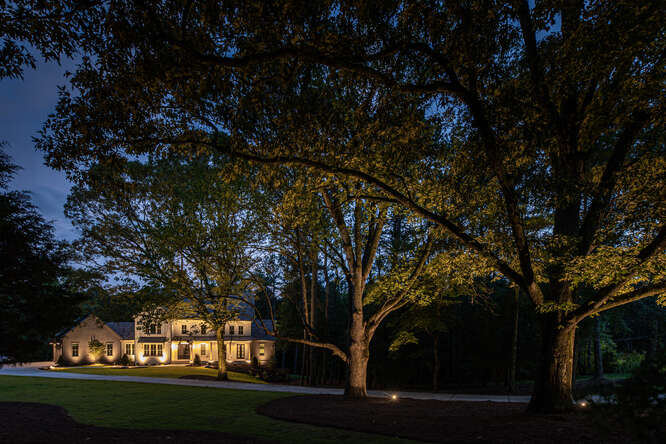
Avoid Costly Lighting Mistakes From the Start
Good uplighting can make your home look warm, welcoming, and secure after dark. It can stretch your outdoor time, show off your favorite trees and brickwork, and help guests find the front door without guessing where to step.
But poor lighting design does the opposite. Even expensive fixtures can look bad if they are placed or aimed the wrong way. That is when you see glare in your eyes, bright hot spots on walls, dark entryways, and lights that feel harsh instead of relaxing. Money gets spent, but the house still does not look right.
We work on outdoor lighting across Atlanta, and we see the same design mistakes over and over, from in-town bungalows to homes on wooded lots. The good news is that most problems come from a few common choices that can be fixed. Let us walk through the biggest design mistakes people make with landscape uplighting in Atlanta, GA, and how to avoid them from the start.
Overlighting Your Home and Yard
One of the biggest problems we see is simply too much light. Many people think more fixtures mean a better result. In reality, more light can wash out the details that make your home special.
Overlighting often shows up as:
- Every few feet of wall lined with a fixture
- Bright bulbs that turn white siding into a glowing sheet
- Trees lit so hard that the bark looks flat and harsh
Too many fixtures or bulbs with very high lumen output can make some areas blinding while others still look dull. Your eyes do not know where to rest, and the house can start to feel more like a parking lot than a home.
In Atlanta, thick trees and leafy shrubs reflect and bounce light around. That means a bright fixture can feel even stronger once it hits all that greenery. Without a careful plan, light spills into the street, into second-story windows, or even into your neighbor’s bedroom. Thoughtful design should:
- Use the fewest fixtures needed to tell the “story” of your home
- Keep brightness levels similar across the front of the house
- Aim light only where it is needed, not out into the sky
Balanced lighting feels calm and welcoming, not loud and glaring.
Ignoring Architectural and Landscape Focal Points
Another common mistake is treating every part of the house the same. People often place lights in a straight row along the foundation, without thinking about what they are really trying to show off.
When you ignore focal points, you may end up:
- Lighting every small shrub the same way
- Leaving the front door in shadow
- Shining strong light on an AC unit or trash area
- Missing the large tree that gives your yard its character
Good landscape uplighting in Atlanta, GA should guide the eye. That means picking a few key features and letting them stand out. For many homes, those focal points include:
- The front entry and porch
- Columns, peaks, gables, or dormers
- Interesting stone or brick details
- A favorite tree or group of trees
By layering light, you create depth. The front door may get a bit more brightness, columns may get gentle uplights, and a big oak or crepe myrtle can glow softly behind or beside the house. This kind of design makes the home look three-dimensional and inviting from the street.
Poor Angles, Glare, and Safety Concerns
The angle of each fixture matters as much as its location. Even with high-quality products, a bad aiming angle can ruin the effect and make your yard less safe.
Common aiming issues include:
- Fixtures pointed straight up so they create a bright circle or “hot spot” on the wall or trunk
- Lights tilted toward the street that shine into drivers’ eyes
- Beams aimed right into neighbors’ windows
- Step or path lights placed so they shine in your face instead of on the ground
Flat-on beams create small areas of strong light and sharp, deep shadows right beside them. A lower, softer angle spreads light more evenly and makes textures look natural. Trees and walls look better when the light “grazes” them, not blasts them.
Safety comes into play too. Poorly aimed uplights can throw strong shadows across steps and walkways, making it harder to see changes in height. That is the last thing you want when friends are arriving later in the evening or kids are moving between the yard and the house. A careful design will:
- Avoid direct glare for people sitting or walking outside
- Keep strong light out of the street and off nearby homes
- Fill in dark patches along main walking paths without overbright spots
Choosing the Wrong Fixtures for Atlanta’s Climate
Our heat, humidity, and frequent storms are tough on outdoor fixtures. One easy mistake is picking products that are not built for long-term use in this kind of weather.
Problems from poor-quality fixtures often show up as:
- Corroded metal and peeling finishes
- Water getting inside the fixture housing
- LEDs changing color over time, so some lights look warmer or cooler than others
- Loose parts that will not stay aimed where you want them
Professional-grade fixtures are designed to handle moisture and temperature swings. Quality materials and good sealing keep water out. LED technology made for outdoor use holds a consistent color, so your yard does not turn into a patchwork of different whites over the years.
It also helps to plan for growth. In Atlanta, plants fill in fast. Flexible fixtures with adjustable beam spreads and swiveling heads make it easier to adapt. As a shrub grows taller or a tree canopy spreads, lights can be shifted or refocused instead of replaced.
Neglecting Seasonal Adjustments and Maintenance
Even the best design will not look good forever without care. Yards change a lot through the year and over time. New growth in spring can block beams, summer leaves can thicken and soak up light, and fall leaf drop can suddenly expose bare trunks and branches.
When lights are “set and forgotten,” you often see:
- Fixtures slowly tilting from foot traffic or shifting soil
- Lights sinking into mulch or getting buried by groundcover
- Lenses coated with dirt, pollen, or hard water spots
- Wires lifted, cut, or chewed so some lights stop working
All of this chips away at the original design, sometimes so slowly that homeowners do not notice until things look very uneven. Regular checks and simple tweaks keep everything working and looking the way it should.
A good maintenance routine often includes:
- Cleaning lenses so light output stays clear and even
- Re-aiming fixtures after storms, yard work, or plant growth
- Trimming plants that block key beams
- Checking connections so every fixture runs as planned
With the long evenings we get here, especially in warmer months, it pays to keep your uplighting in top shape so your home always looks its best after dark.
Get Started With Your Project Today
Transform your yard into a welcoming, beautifully lit space with expert design and installation from Outdoor Lighting Perspectives of Atlanta. Explore how our custom landscape uplighting in Atlanta, GA can highlight your home’s best features and improve outdoor safety. We will walk you through every step, from design concepts to final adjustments, so your lighting looks just right every evening. Have questions or ready to schedule a consultation? Simply contact us and we will help you get started.